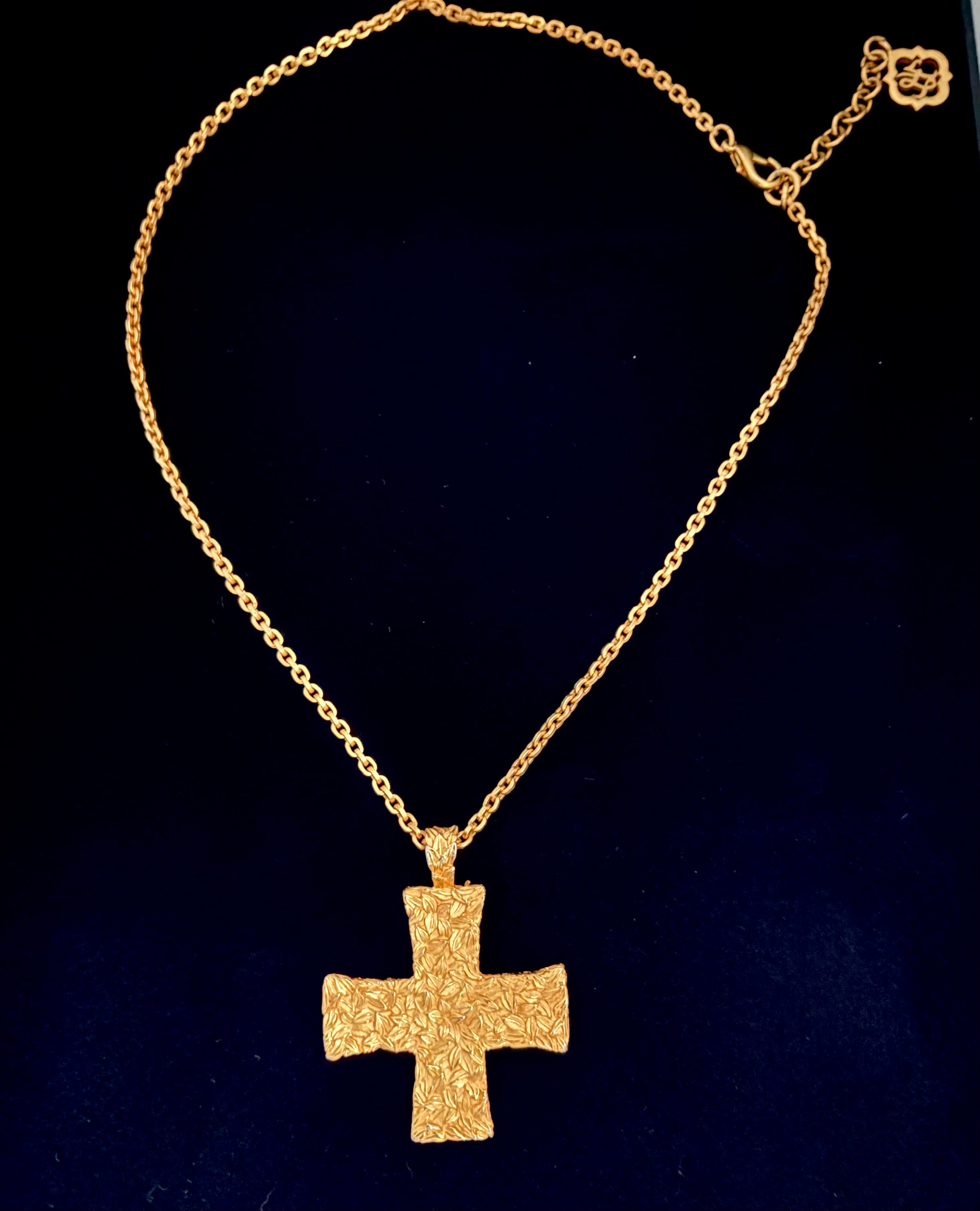
KARL LAGERFELD CROSS PENDANT NECKLACE, CIRCA 1990
I. The Object
An equal-armed Greek cross in gold-tone base metal, its entire surface worked in dense botanical relief — leaf forms pressed so tightly together the metal reads almost textile. The geometry is severe: the cross form is architectural, the arms precisely proportioned. The surface is not: the botanical texture softens the geometry and catches light at every angle differently, giving the piece a richness that contradicts its formal severity. The pendant is suspended from a substantial rolo chain and finished with an extender terminating in the signature KL monogram charm within a quatrefoil frame.
Authentication: The reverse of the cross carries the KL medallion hallmark — a secondary Medusa-style relief medallion with the KL monogram, one of Lagerfeld's most consistent jewelry signatures. The KL monogram extender charm on the chain is the second authentication mark. The botanical texture treatment and the cross form are characteristic of Lagerfeld's jewelry output from the late 1980s and early 1990s.
II. What It Meant When It Was Made
Karl Lagerfeld spent his entire career refusing to be owned by a single aesthetic, which is precisely why his jewelry from the late 1980s and early 1990s is so revealing. It is the jewelry of a man who was simultaneously designing for Chanel, for Fendi, and for his own label — a man who had so thoroughly internalized the grammar of European fashion history that he could deploy any element of it with complete conviction and zero sentimentality.
The cross pendant he returned to repeatedly during this period was not devotional. It was architectural. Lagerfeld was interested in the cross as a form — the perfect geometric tension of equal arms, the horizontal cutting the vertical, the visual weight distributed across four axes simultaneously. He was interested in it the way he was interested in all historical forms: as raw material for formal investigation.
The botanical texture that covers this cross is similarly non-literal. Leaf forms, yes — but compressed and abstracted to the point where the reference to nature is almost irrelevant. What remains is surface density, the relationship between the geometric ground and the organic texture applied to it. The severity of the cross form and the richness of the botanical surface are in deliberate tension. That tension is the piece.
By 1990, Lagerfeld was arguably the most powerful figure in European fashion — not because he had built the biggest house, but because he had demonstrated that a designer could maintain complete aesthetic independence while working within multiple inherited identities simultaneously. His jewelry was the place where that independence was most legible: objects made entirely according to his own logic, without the gravitational pull of Chanel's history or Fendi's commercial requirements.
III. What Was Lost After
Lagerfeld's independent jewelry line eventually became diffusion product — the signatures remained, but the craft intention behind them shifted as the line was optimized for broader distribution and lower price points. A cross pendant from 1990 was a considered object: botanical texture achieved through a specific casting and finishing process, KL hallmark applied with the same seriousness as a fine jewelry maker's mark, chain weight proportioned for the pendant's mass.
What came later was a logo on a chain. The KL monogram remained. The intention behind it changed.
Lagerfeld died in February 2019. The Karl Lagerfeld brand continues under new creative direction. The jewelry continues to be produced. But the pieces made while he was alive and directing the line — particularly the pieces from the late 1980s and early 1990s, before the diffusion optimization — are a closed category. This cross is from that category.
IV. Why It Matters Now
The Lagerfeld cross matters in the PSV archive as a demonstration that significance is not limited to the houses with the most obvious cultural narratives. Versace's murder, Lacroix's bankruptcy, Dior's wartime history — these are dramatic stories that frame the objects they produced. Lagerfeld's story is quieter: a designer who maintained complete creative independence across a fifty-year career and left behind, in his independent jewelry line, some of the most formally rigorous objects of the period.
The cross with botanical texture is not a statement piece in the theatrical sense. It is a thinking piece — an object that rewards attention, that discloses its logic gradually, that is more interesting the more you know about what Lagerfeld was doing formally and why.
Excellent vintage condition. Bright, even gold tone throughout. Minimal signs of wear.
Details
Designer: Karl Lagerfeld | Era: Late 1980s–1990s | Material: Gold-tone base metal | Pendant: Greek cross with all-over botanical texture | Chain: Rolo / cable chain | Closure: Lobster clasp with extender | Signature: KL medallion hallmark on reverse, KL monogram extender charm | Condition: Excellent


Leave a comment
This site is protected by hCaptcha and the hCaptcha Privacy Policy and Terms of Service apply.