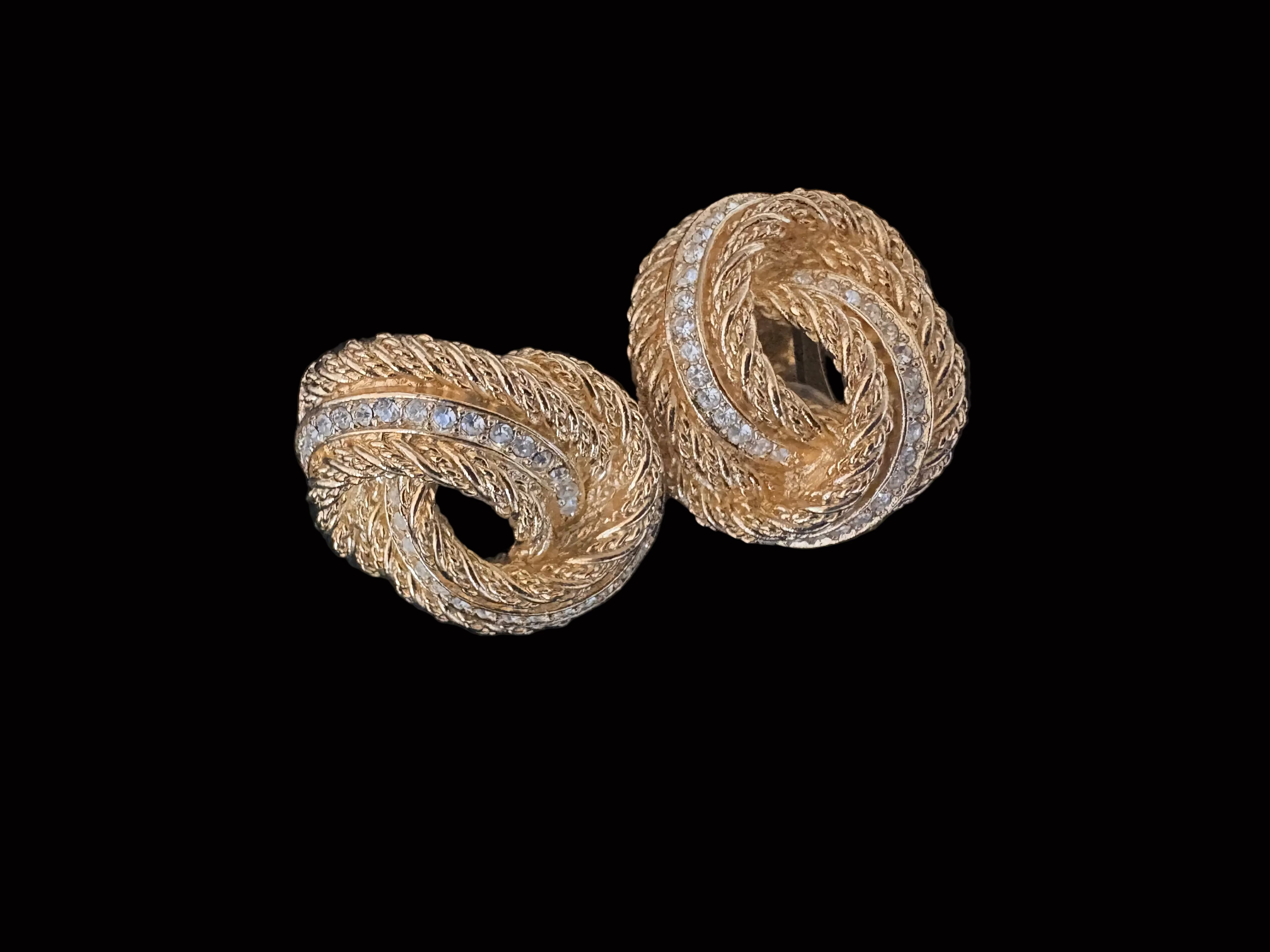
CHRISTIAN DIOR ROPE KNOT CLIP EARRINGS, 1980s
I. The Object
Each earring is formed from what appears to be a continuous braided rope cord that folds back on itself into a tight circular knot. The twisting strands catch light at different angles, creating movement across the surface even though the form itself is compact.
Running through the center is a narrow channel of clear rhinestones. The stones are set within the architecture of the knot rather than applied to a flat surface. Light therefore emerges from the structure of the form rather than sitting on top of it.
The clip mechanism is substantial and functions correctly.
Condition is New Old Stock, meaning the earrings show no wear despite being more than three decades old. The gold tone remains bright, and there is no plating loss at the points where clips normally show friction.
Authentication: stamped CHR. DIOR © on the clip mechanism, the mark used on Dior costume jewelry throughout the late twentieth century.
II. What It Meant When It Was Made
The knot is one of the oldest recurring motifs in jewelry.
Forms resembling the Hercules knot appear in ancient Egyptian pieces. The Gordian knot became a symbol of complexity and power in classical mythology. Across European decorative arts the knot came to represent continuity, permanence, and bonds that cannot easily be undone.
Twentieth-century jewelers returned to the motif repeatedly. Tiffany made the knot a signature element in several of its collections. Italian ateliers such as Bulgari and Buccellati used rope and knot forms as demonstrations of technical modeling.
The rope knot form is deceptively difficult to execute. For the illusion to work, the cord must appear continuous and inevitable rather than constructed from separate parts.
Dior’s costume jewelry designers in the 1980s translated that vocabulary into pieces intended for everyday wear. The rhinestone channel running through the center of the knot shows that the translation was taken seriously. Setting stones within the compressed curves of a knot is more demanding than applying them to a flat surface.
Someone at Dior made the decision to do it properly. The result still shows.
III. What Was Lost After
The 1980s were a period when Dior’s costume jewelry frequently reflected the construction values of the couture house itself.
By the 1990s the structure of the luxury industry had changed. Expansion, licensing, and the demands of global retail pushed costume jewelry production toward efficiency.
The rope knot form remained part of the visual vocabulary. What diminished was the level of craft investment within the form. Details such as stones set inside the architecture of the knot became less common because they required additional labor.
This pair belongs to the moment just before that shift became dominant.
IV. Why It Matters Now
The significance of these earrings is not tied to a runway moment or a celebrity provenance.
Their importance lies in something quieter. They were made well, to a standard that the market no longer routinely demands, and they have survived in the condition of their making.
The CHR. DIOR © stamp confirms they were produced under the authority of one of the most technically demanding fashion houses in the twentieth century.
Their New Old Stock condition adds another layer to the story. These earrings were made in the 1980s, purchased, and then never worn. They exist today exactly as they left the workshop.
That is a form of preservation. And it allows the object to be seen as it was originally intended.
Details
Designer: Christian Dior | Era: 1980s | Material: Gold-tone base metal, rhinestone pavé channel | Form: Rope knot clip earrings | Closure: Clip-on | Signature: CHR. DIOR © on clip mechanism | Condition: New Old Stock — unworn

Leave a comment
This site is protected by hCaptcha and the hCaptcha Privacy Policy and Terms of Service apply.